Our 2021 “Be Car Smart” Safe Driving Quiz

Our 2021 “Be Car Smart” Safe Driving Quiz

Depending on what state you live in and how old you are, it may have been a while since you took a driving test. And if you’ve worked from home during the coronavirus pandemic, you may be driving far less than you used to. Take our “Be Car Smart” safe driving quiz to refresh your knowledge and make sure you’re up to speed on driving safety. Check your answers at the end of this post.

1 – How much room should there be between your chest and the steering wheel?

a. Less than 6 inches
b. 6 to 8 inches
c. 8 to 10 inches
d. 10 to 12 inches

2 – What is a safe and efficient steering wheel hand position?

a. 10 and 2 o’clock position
b. 9 and 3 o’clock position
c. 7 and 4 o’clock position
d. One hand on the wheel at the 12 o’clock position

3 – When should you avoid passing another vehicle?

a. On a hill or curve
b. At any railroad crossing
c. Road construction area
d. All of the above

4 – You should use your signal __ feet prior to making a turn.

a. 25
b. 50
c. 75
d. 100

5 – When driving, how much distance should you keep between your car and the vehicle in front of you?

a. 3 feet behind the car you are following
b. 3 car lengths behind the car you are following
c. 3 seconds or more behind the car you are following
d. 30 seconds behind the car that you are following

6 – Which situation is NOT a rule for yielding right of way?

a. If two vehicles begin to enter an intersection at the same time and there are no traffic signs or signals, drivers should motion to each other to decide who goes first.
b. You are required to yield to any authorized emergency vehicle, such as police cars, fire engines and ambulances, when these vehicles are giving a signal by siren or flashing lights.
c. You must yield the right of way to school children entering or leaving a school bus.
d. If you have stopped for a traffic light at an intersection and want to turn left when the green light appears, you must yield to traffic that is waiting on the opposite side of the traffic light.

7 – Statistically speaking, your chances of collision are highest:

a. On a highway
b. At an intersection
c. When pulling out of a parking space
d. When passing another vehicle

8 – Roundabouts are found to result in __ crashes than traditional intersections?

a. Fewer
b. More
c. The same amount of
d. Higher Impact

9 – Can you make a right turn on a red light at an intersection with a red-light camera?

a. Yes, if you come to a complete stop before making your turn.
b. No. Wait for the light to change to green before making your turn.
c. Yes. Slow down, check to see if it is clear, and make your turn.
d. Both A and C.

10 – In 2021, how many US states have a ban on texting while driving?

a. 24
b. 44
c. 48
d. 50

Answers:

1 – How much room should there be between your chest and the steering wheel?

Answer: D. 10 and 12 inches. Keeping 10 to 12 inches between your chest and the steering wheel (from your breastbone to the center of the wheel) will protect yourself in case the airbag suddenly deploys. Airbags can deploy at speeds of up to 200 mph and could cause serious injury if you are too close to the wheel or sitting in the wrong position.

2 – What is a safe and efficient steering wheel hand position?

Answer: B. 9 and 3 o’clock. The old school wisdom was to position hands at 10 and 2 o’clock. As air bags became common, this led to the wrist and arm fractures when air bags deployed. To avoid that occurrence, many safety advocates now recommend positioning hands lower, at 9 and 3 o’clock on the steering wheel.

3 – When should you avoid passing another vehicle?

Answer: D. All of the above.

4 – You should use your signal _ feet prior to making a turn.

Answer: D. 100 feet. Get into the proper lane and give a signal for at least 100 feet (about a quarter length of an average city block) before reaching the intersection and making the turn.

5 – When driving, how much distance should you keep between your car and the vehicle in front of you?

Answer: C. Three seconds. To achieve the three second spacing between you and the car ahead of you, when that car passes a landmark, such as a tree or an exit sign, start counting. If you pass the same spot before you count to three, you’re driving too close to the other car.

6 – Which situation is NOT a rule for yielding right of way?

Answer: A. If two vehicles begin to enter an intersection at the same time and there are no traffic signs or signals, the vehicle on the left must yield to the driver on the right.

7 – Statistically speaking, your chances of collision are highest:

Answer: B. Intersections. Crashes often occur at intersections because there are a variety of activities such as turning left, crossing over, turning right, red camera lights, and pedestrians causing a higher possibility for conflicts.

8 – Roundabouts are found to result in __ crashes than traditional intersections?

Answer: A. Fewer. Roundabouts – also known as traffic circles – result in slower speeds and fewer crashes, especially the right-angle and head-on crashes that often result in injuries or even deaths.

9 – Can you make a right turn on a red light at an intersection with a red light camera?

Answer: A. Yes, but make a complete stop. The law requires motorists to come to a stop before making the right turn on a red signal. The camera will capture your illegal turn as a red light violation if you don’t stop.

10 – In 2021, how many US states have a ban on texting while driving?

Answer: C. Currently, 48 states, D.C., Puerto Rico, Guam and the U.S. Virgin Islands ban text messaging for all drivers.

After an Accident, Find a Collision Repair Shop on Carwise.com

Accidents happen, even to the most careful drivers. If you’re ever in a collision, follow these tips for post-accident safety and when it’s safe, use Carwise.com to find a reputable auto body repair shop near you. From reviews by real customers to services and payment information, Carwise has details on over 21,000 auto body and collision repair shops. Use Carwise’s shop finder tool to search your zip code for a customer-reviewed auto body shop nearby: https://www.carwise.com/auto-body-shops/.

Read More
5 Tips for Staying Safe and Social Distancing After an Auto Accident This Winter

5 Tips for Staying Safe and Social Distancing After an Auto Accident This Winter

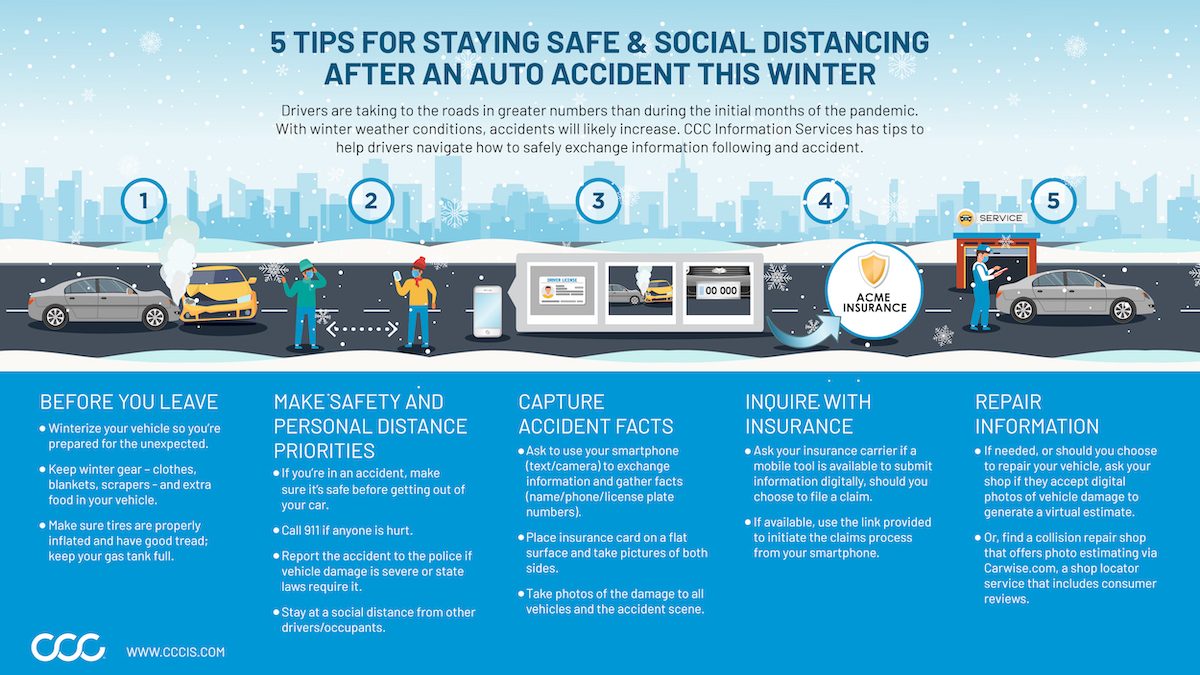
Drivers are taking to the roads in greater numbers than during the initial months of the pandemic. With winter weather conditions, accidents will likely increase. With elevated COVID-19 cases across the United States, this may increase the risk for drivers to contract the virus after an accident occurs. Here are some tips to help drivers navigate how to safely exchange information following an accident, as well as get a vehicle appraised and repaired.

Before You Leave

  • Winterize your vehicle so that you’re prepared for the unexpected.
  • Keep winter gear – clothes, blankets, ice scrapers – and extra food in your vehicle.
  • Make sure your vehicle’s tires are properly inflated and have good tread, and keep your gas tank full.

Make Safety And Personal Distance Priorities

  • Make sure the roadway is safe before getting out of your car.
  • Call 911 if anyone is hurt.
  • Report the accident to the police if vehicle damage is severe or state law requires it.
  • Maintain a social distance of six feet from other drivers, occupants, and any first responders.

Capture Accident Facts

  • Ask the other driver(s) to exchange information via text (names, phone numbers, license plate numbers, as well as vehicle descriptions, including make, color, and model).
  • Place insurance card and driver’s license on a flat surface and take pictures of both sides, and share with the other driver(s).
  • Take photos of the damage to all vehicles involved and the accident scene.

Inquire with Insurance

When you contact your insurance carrier to inform them of the accident, ask if they have a mobile tool available to submit information digitally, should you choose to file a claim. If available, use the link provided to initiate the claims process from your smartphone.

Repair Information

If your vehicle requires, or should you choose to repair your vehicle, ask your shop if they accept digital photos of vehicle damage to generate a virtual estimate. You can also search for a collision repair shop that offers photo estimating via Carwise.com.

When your vehicle has been involved in an accident, you can locate auto body or glass repair shops by searching on Carwise.com. Use Carwise’s shop finder tool to search your zip code for a customer-reviewed auto body or glass repair shop nearby: carwise.com/auto-body-shops/.

Read More
5 Steps to Take After Witnessing a Car Accident

5 Steps to Take After Witnessing a Car Accident

You’re driving home on a busy road after work one day approaching a traffic light.  Just before you reach the intersection you see an auto accident unfold right before your eyes.  What should you do?  It’s been a long day and your first instinct is to drive away and ignore what you saw.  But then you consider how you’d feel if the tables were turned and you were one of the shaken drivers still strapped inside your freshly-damaged vehicle.  So as a good citizen you decide to stop your car and lend assistance.  But doing the wrong thing when you’re at a crash scene can actually make the situation worse for all parties involved, and even endanger you.  On the positive side, there are some actions you can take that will help ensure the victims’ safety, and that the authorities have the information they need.  Based upon the advice of insurance industry experts, here are some key steps to take after witnessing a car accident.

  1. Get Yourself out of Harm’s Way

All around the damaged vehicles could be broken glass, coolant, metal debris and leaking fuel.  There will also be passing cars to contend with.  To protect yourself from danger, pull your car to the side of the road at least 100 feet from the accident scene, and turn on your hazard lights.  Make sure that your vehicle is well away from moving traffic.

  1. Dial 911 and Provide Details

Never assume that another party called 911, and especially if one or more vehicles is on fire.  Call 911 immediately and tell the operator you’ve witness an accident, the location, number of vehicles and persons involved, possible injuries, and any other useful information.

  1. Calmly Check the Victims

Remaining calm, walk over to the vehicles and check on the victims.  Look for small children and infants in the back seat.  Calmly ask the drivers to place their cars in “park” and to turn off the ignition.  Don’t play judge regarding who’s at fault, but rather focus on the initial safety of all parties involved.  If there’s an immediate fire risk try to get the victims out of harm’s way.  Otherwise, never attempt to move an injured person, but instead comfort and reassure them until trained medical personnel arrive.

  1. Talk to the Police

Once the police arrive at the scene, let them know you are a witness and provide them with honest, relevant details about what you observed leading up to the accident.  Do not mention anything about who might have been at-fault to the involved drivers, as there could be backlash directed towards you later.  Instead, give the police those details so that they can conduct an accurate investigation.  They will also want your name and contact information.  If you have specifics that would benefit the medical personnel at the scene, let them know as well.  Always remember to tell the truth based upon what you saw.

  1. Make Yourself Available Later

Even after your leave the accident scene, you could be contacted later for a statement by medical authorities, insurance adjusters or police officers.  Always honestly and factually relate what you observed to the best of your ability.  In the end, rest assured that you did the right thing as a responsible witness, and that someday someone might repay the favor for you!

Body Shops Nearby Repair Accident Damage

When you’re involved in a car accident it’s stressful.  The first step is to ensure that you and your passengers get the medical attention you need.  After that’s done, bring your vehicle to a reliable auto body shop in your area and they’ll fix the collision damage expertly and promptly, while restoring your peace-of-mind.  Body shop technicians have the experience, know-how and training to get your car looking and performing like new again, and quickly get you safely back on the road.  To search your zip code now for a better collision repair shop in your area, visit: www.carwise.com.

Read More
Top 10 Things to Do After a Car Accident

Top 10 Things to Do After a Car Accident

Getting into a car accident can be a traumatic and stressful event. It may be hard to think clearly and remember what to do immediately after a car accident happens. In the event of a car accident, there are some important things to remember:


Stop immediately and do not leave the scene of a car accident

Without endangering others or obstructing traffic, stop your vehicle as soon as you can. Don’t leave the scene of a car accident unless injuries force you to do otherwise.

Keep calm and think about your safety

Your first priority is to keep calm and consider the safety of everyone involved in the car accident to prevent more collisions or injuries. Move to a safe location if you are concerned about your safety. Do not get do not get out of your car unless it is safe. Ask everyone involved in the car accident if they are okay.

Call 911

After the car accident, the other driver involved might not want to call the police and may want to settle things between just the two of you. Ignore their request and call the police, even if it’s just a minor car accident, because:

1) In most states you are required to call the police by law after a car accident.
2) An official police report is one of the most credible documents the insurers will use to determine fault.
3) Officers are trained at detecting staged a car accident and can help protect you from fraud.
4) Emotions can run high after a car accident, and a police presence can be there to act as an impartial referee can make sure that things don’t get too heated.

Listen to the police and follow their instructions

Police officers are trained to handle various situations that might happen after a car accident. Even though you may not think are physically injured, you may be in shock, and your emotions may make it hard to think clearly. A police officer can assess the situation and determine if medical assistance is required.

Exchange information

Give the other drivers involved in the car accident and the police the following information: your name, driver’s license and insurance information.

Be polite, but don’t discuss who is at fault with other parties

The law does not require you to admit fault, and you should not blame or acknowledge guilt at the scene of the car accident.

If there are any witnesses, get their name and contact information

Ask for a brief summary of what they saw and take notes.

Take notes immediately

Thinks may be chaotic after a car accident, and it can be difficult to remember things later. Take written notes as soon as possible after the car accident, and be as specific as possible. Use your cell phone to take pictures and document the car accident. The more pictures, the better.

Report your claim 

Many state laws require that the driver of any vehicle involved in an accident resulting in injury, death, property damage in excess of $1500, or the towing of any vehicle, must file an official accident report with the state within 72 hours after the accident.

Arrange your car accident repairs

If your car requires auto body repair after your car accident, we recommend that you find a good auto body shop near you. At Carwise.com, you can find an auto body shop with real customer reviews and ratings. You can also track your car’s repair status through the Carwise website or mobile app if your vehicle is being repaired at one of the shops in our network of auto body shops.

Sources:
USSA.com
NAIC.org
OSBAR.org

Read More