How Do I Fix My Cracked Windshield?

How Do I Fix My Cracked Windshield?

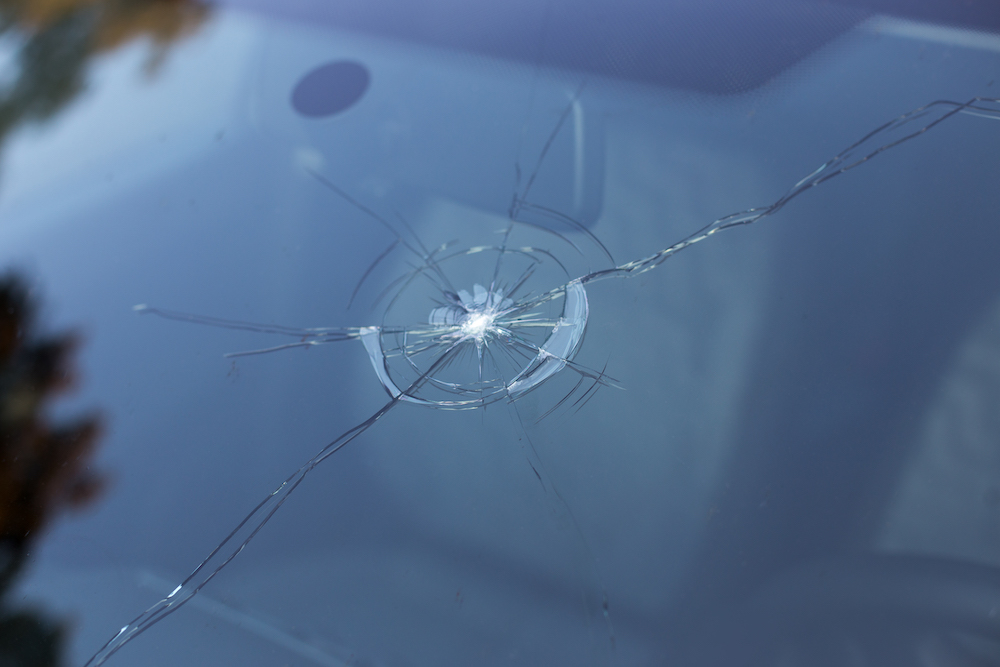
Whether it happened because of flying debris or as the result of a car accident, a cracked windshield is never a good thing. You might be tempted to ignore it if it’s not interfering with your ability to see as you drive. However, it’s important to know that even small cracks and chips can spread quickly, presenting several risks.

The Risks to Driving with a Cracked Windshield

  • You could get ticketed for having a cracked windshield. Windshield cracks become dangerous once they’re large enough to interfere with your field-of-vision. In many states, you can be ticketed if a police officer deems your cracked windshield to be unsafe.
  • Weather can make windshield cracks worse. Moisture can drip into a chip or crack, and cold temperatures can cause the moisture to freeze and expand, making the crack spread.
  • Cracked windshields can make car accidents more dangerous. Auto glass contributes to the overall structural integrity of the vehicle. Intact windshields are designed to transfer the force of a frontal collision down into the chassis, which lessens the impact you and your passengers feel. If your windshield is already cracked when you get into an accident, the glass is more likely to shatter during a front-end collision and your vehicle’s roof is more likely to collapse in a rollover accident. A cracked windshield can also interfere with airbag deployment because it is less likely to hold up to the force, increasingly the possibility of serious injury or even death.

Temporary Windshield Fixes

Windshields with cracks of any size need to be replaced as soon as possible. Do-it-yourself windshield repairs or replacements are never wise for several reasons; you don’t want to do anything that could exacerbate the damage or interfere with your ability to drive the vehicle safely. However, when you’re in the process of scheduling a professional repair or replacement, there are temporary measures you can take to help keep the crack from spreading.   

  • Protect the glass from extreme conditions. Park in the shade when it’s hot and if possible, park in a garage or carport to protect the auto glass from water and direct sunlight. If you can’t park in a garage or carport, covering the vehicle with a tarp can protect the crack from moisture.
  • Try a windshield repair kit. If you’re handy and the crack is very small, or it’s only a chip, auto parts stores sell windshield repair kits that contain resin. Just keep in mind that in many cases, DIY repairs do not last like those done by professionals and the crack may still spread.

When to Take A Cracked Windshield to an Auto Glass Shop

It’s important to seek repairs for your damaged windshield as soon as possible, even if the crack or chip is small, because the damage can spread over time. Even minor

scratches, nicks, chips and cracks can spread, leading to more expensive repairs and potentially a full auto glass replacement. We recommend seeking advice from a professional at a local auto glass repair shop as soon as it happens, even if the damage appears to be minor.

Should I Repair or Replace My Cracked Windshield?

In the past, having a chipped or cracked windshield always required replacement. Recent innovations to auto-glass repair makes windshields more repairable, but it depends on the size, location and severity of the damage.

Auto Glass Repair

Auto glass repair is a quicker, cost-effective solution than an auto glass replacement, if the chip or crack is small enough. Generally, chips smaller than a quarter and cracks less than three inches long can be repaired. Anything larger will likely require a full replacement. A quality auto glass repair can prevent a chip or crack from spreading and help hide the original damage without having to remove the original glass. You’ll need to act quickly to get an auto glass repair, otherwise replacement will become your only option because driving with a cracked windshield can cause the damage to spread, for a variety of reasons.

An auto glass repair is a simple procedure that typically takes less than an hour: the technician uses a small suction vacuum to remove any moisture or other matter from the crack and injects resin to fill it. If done properly, windshield crack repair can be a safe and permanent solution to a damaged piece of auto glass.

Auto Glass Replacement

Auto glass replacement is typically more expensive than an auto glass repair, but it is often the best way to make sure that your vehicle is safe to drive. The location of the windshield damage plays an important factor in determining whether or not you’ll need an auto glass repair or replacement. For example, a crack on the edge of your windshield can spread quickly and compromise the structural integrity of the glass, making replacement the safest option in those cases. If the damage is in the line of sight of the driver, the auto glass shop will likely recommend a full replacement even if it is a small chip, because an auto glass repair on a chip may leave minor distortions in the glass. If a crack is deep enough to penetrate the clear layer of plastic that prevents a windshield glass from shattering, they will likely recommend a full replacement as well.

An auto glass replacement typically takes longer than a repair; you may have to wait a few hours before driving your vehicle to let the urethane that bonds the glass to cure.

How to Find a Local Auto Glass Repair Shop

A professional technician at your local auto glass repair shop will be able to quickly inspect and assess the damage to your cracked windshield and help you determine whether you will need to repair or replace the glass.

Carwise.com makes it easy to find a reputable auto glass repairer and request an estimate. From reviews by real customers to services and payment information, Carwise has details on over 21,000 repair shops. Use Carwise’s shop finder tool to search your zip code for a customer-reviewed auto body or glass repair shop nearby: https://www.carwise.com/auto-body-shops/.

Read More
Understanding Shop Certifications

Understanding Shop Certifications

When your car needs a repair, it’s helpful to find a shop that is equipped to handle your vehicle’s specific make and model. Vehicles can vary widely, from the type of frame a car uses to the technology embedded in it. Auto body and glass shops can obtain different certifications that let consumers know what that shop excels in and what type of cars they specialize in repairing.

There are three major types of certifications that body shops or technicians can acquire.

ASE Certification

ASE stands for the National Institute for Automotive Service Excellence. ASE is an independent, non-profit organization that works to improve the automotive industry by testing and offering certifications for professionals in the field.

ASE Certification requires automotive technicians to have two years of on-the-job training or one year of training along with a two-year degree in automotive repair, and they must pass the ASE test. Certifications can be obtained in sub-specialties as well, including automobile, medium/heavy repair, school bus repair, collision repair and more. This certification includes both mechanical and cosmetic certifications. In total, there are more than 40 certifications that a technician can obtain through ASE.

I-CAR Certification

I-CAR stands for Inter-Industry Conference on Auto Collision Repair, and certification through I-CAR is considered to be the gold standard for an auto shop. I-CAR is also a non-profit organization, and it offers classes, training activities and resources, along with certifications.

The highest certification offered is the Gold Class® recognition. I-CAR uses this certification to identify repair technicians who have been trained on the latest vehicle models, technologies and repair methods. Currently, only about 20% of collision repair shops are Gold Class certified.

OEM Certification

OEM stands for original equipment manufacturer – the different manufacturers or brands of car you can buy, like a Honda or Ford. You may think that to get a specialist in your car’s brand you have to go to a dealership, but if a shop is OEM certified, they are approved by the auto manufacturer to work on that specific brand of vehicle, and will most likely use OEM factory-approved parts, tools and procedures to install those parts.

Choosing a Shop

When selecting a repair shop for your car, there are many things to consider – and Carwise.com makes it easy to quickly review the most important areas.

  • Reviews. On Carwise, read reviews from real customers to see what type of experience you can expect at local shops. Many of these reviews also include the type of car the customer brought in.
  • Services & Payment Info. See what services a shop offers and the types of payment they accept, all on the same page as the reviews.
  • Certifications. Under the services, you can see which certifications a particular shop has to find one that specializes in repairing vehicles with your specific make and model. These certifications may include those outlined above.

Carwise has details on over 21,000 repair shops with current ratings and reviews. Use Carwise’s shop finder tool to search your zip code for a customer-reviewed auto body or glass repair shop nearby: https://www.carwise.com/auto-body-shops/.

Read More
5 Tips for Staying Safe and Social Distancing After an Auto Accident This Winter

5 Tips for Staying Safe and Social Distancing After an Auto Accident This Winter

Drivers are taking to the roads in greater numbers than during the initial months of the pandemic. With winter weather conditions, accidents will likely increase. With elevated COVID-19 cases across the United States, this may increase the risk for drivers to contract the virus after an accident occurs. Here are some tips to help drivers navigate how to safely exchange information following an accident, as well as get a vehicle appraised and repaired.

Before You Leave

  • Winterize your vehicle so that you’re prepared for the unexpected.
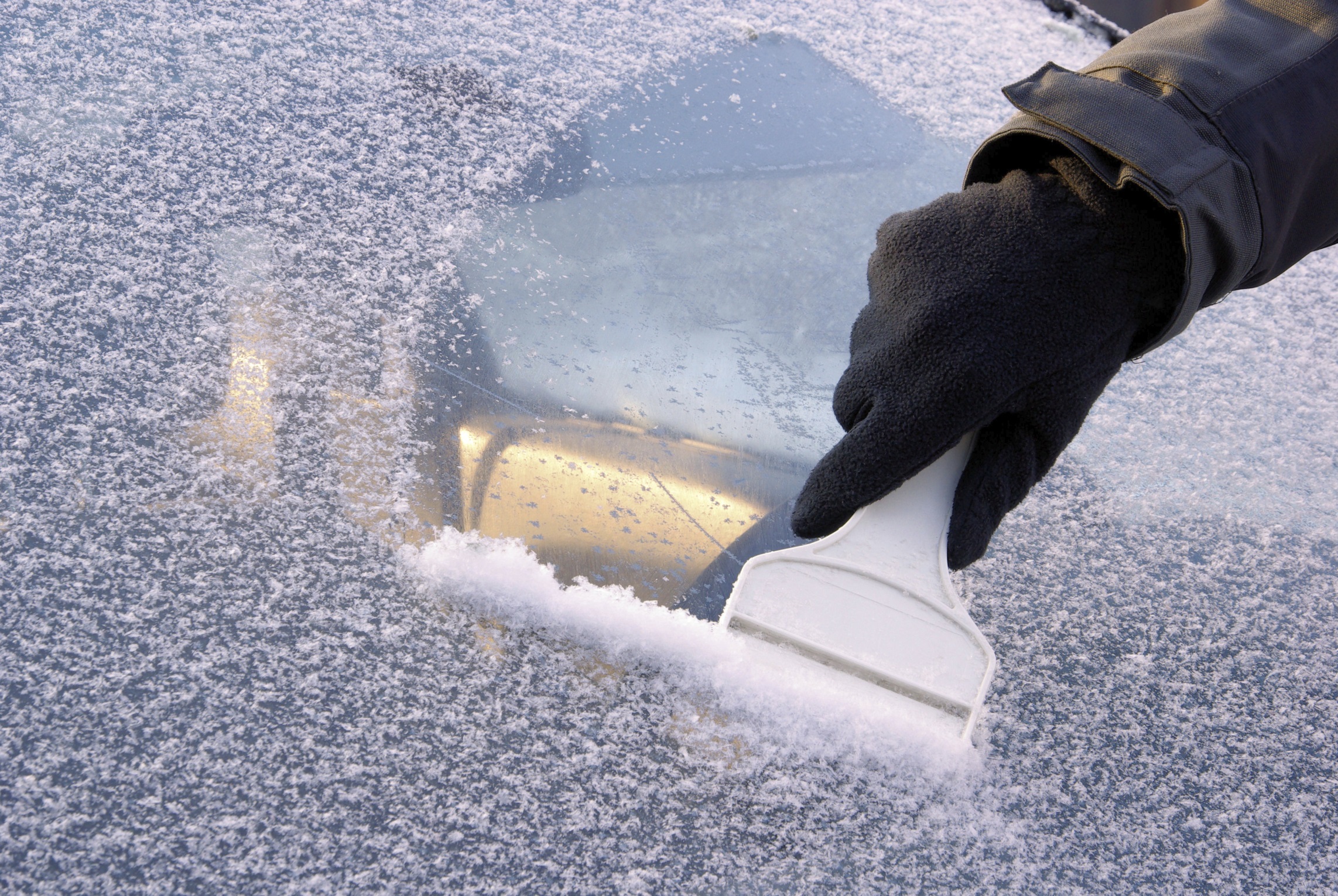
  • Keep winter gear – clothes, blankets, ice scrapers – and extra food in your vehicle.
  • Make sure your vehicle’s tires are properly inflated and have good tread, and keep your gas tank full.

Make Safety And Personal Distance Priorities

  • Make sure the roadway is safe before getting out of your car.
  • Call 911 if anyone is hurt.
  • Report the accident to the police if vehicle damage is severe or state law requires it.
  • Maintain a social distance of six feet from other drivers, occupants, and any first responders.

Capture Accident Facts

  • Ask the other driver(s) to exchange information via text (names, phone numbers, license plate numbers, as well as vehicle descriptions, including make, color, and model).
  • Place insurance card and driver’s license on a flat surface and take pictures of both sides, and share with the other driver(s).
  • Take photos of the damage to all vehicles involved and the accident scene.

Inquire with Insurance

When you contact your insurance carrier to inform them of the accident, ask if they have a mobile tool available to submit information digitally, should you choose to file a claim. If available, use the link provided to initiate the claims process from your smartphone.

Repair Information

If your vehicle requires, or should you choose to repair your vehicle, ask your shop if they accept digital photos of vehicle damage to generate a virtual estimate. You can also search for a collision repair shop that offers photo estimating via Carwise.com.

When your vehicle has been involved in an accident, you can locate auto body or glass repair shops by searching on Carwise.com. Use Carwise’s shop finder tool to search your zip code for a customer-reviewed auto body or glass repair shop nearby: carwise.com/auto-body-shops/.

Read More
Vehicle Emergency Kits for Winter

Vehicle Emergency Kits for Winter

What you will need for your winter car kit

Just as you may have a tornado or severe storm kit in your basement, it’s a good idea to keep an emergency kit in your car in case of extreme conditions.  In the winter months especially, there are many items that could prove to be very useful in an unfortunate weather-related situation or accident that causes you to be exposed to extreme temperatures.

Start your kit with some basic essentials, such as non-perishable food items (i.e. canned goods or snacks), and bottled water.   Pack enough for all the people typically in your car.

Next, a few handy tools to add to your kit include:

  • A windshield ice scraper
  • A multi-purpose utility tool, such as a pocket knife
  • An LED flashlight with spare batteries
  • And a bag of cat litter

Yes, you read that right.  Cat litter is a great, lightweight alternative to salt or sand that can be used to free your car from snow banks or icy patches.

A classic first-aid kit may be in your car already, but it’s worth a second look to ensure it still has a full supply.  Lastly, tucking a warm blanket in your trunk is also a good idea in case your car won’t start, or you have to wait for assistance in cold temperatures.

Take a look at which of these items you already have in your car, and consider adding the ones you don’t.  You will be happy you did if you ever come across a situation when you need them.  Leave a comment below with any items you would add to our list!

Read More
How Auto Body Shops Identify Unseen Damage After a Collision

How Auto Body Shops Identify Unseen Damage After a Collision

How Auto Body Shops Identify Unseen Damage After a Collision

A dented bumper, scratched paint, a broken windshield—the aftermath of a car accident is often accompanied by a visible reminder. However, it is important to know not all damage following an accident is visible. This can be especially true in newer vehicles that include automated driver assistance systems (ADAS) as these sensors and components are often not visible.

After a collision, when assessing the damage, you may want to bring the vehicle to a professional to determine if the damage is cosmetic or if there is unseen damage that could impact vehicle performance or safety features.  

Unseen Technologies

Many newer vehicles include a variety of sensors to guide driver assistance technology. Often sensors are located in the front and rear bumpers as well as throughout the interior and exterior of the vehicle. These sensors work together with onboard computers to allow features like parallel parking assistance, rear cameras for assistance backing up, and even collision prevention measures. Following an accident, it is important to confirm that your systems are fully operational.

Fortunately, auto body shops have various ways to detect this unseen damage, and one of the most important is diagnostic scanning.

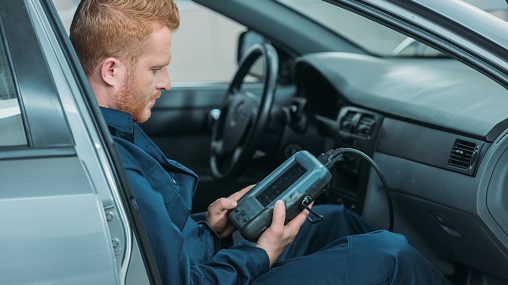
A diagnostic scan is performed after you drop your car off at the shop, before repair work begins. To perform a diagnostics assessment, a repair technician connects your car to a scanner, which reveals if any Diagnostic Trouble Codes (DTC) appear. This scan runs through all the various programs and features that help your car run, and it flags any problems or miscommunications between those systems.

This scan gives auto repairers visibility into seen and unseen systems.

If you’re in an accident, it is important to remember to think about unseen damage as well. You can always play it safe and contact a local collision repair professional to determine the extent of the damage. Carwise is happy to connect you to local professionals, many of which offer photo estimates online. Use the shop finder tool on Carwise to search your zip code for a customer-reviewed auto body or glass repair shop nearby: https://www.carwise.com/auto-body-shops/.

Read More
Top 10 Questions to Ask an Auto Body Repair Shop

Top 10 Questions to Ask an Auto Body Repair Shop

One of your first priorities after getting in a car accident is getting your vehicle repaired as quickly as possible. But hastily taking your vehicle to the closest auto body repair shop may not be the best decision when all is said and done. Finding a reputable collision repair shop can be challenging and will take some research on your part. Before handing over your keys to the body shop manager here are 10 questions to ask:

What Do Others Say About the Collision Repair Shop?

The first step to finding a trustworthy auto body repair shop is to carefully research the shops in your area online. Blog articles, customer reviews and third-party ratings can help you find and choose from the most reputable shops nearby.

How Does the Shop Communicate with Customers?

Many – but not all – auto body repair shops have adopted new technology to make it easy for customers to book appointments online, submit photo estimates from your smartphone, and stay in the loop about the status of a repair with text or email updates. These features aren’t mandatory but are worth considering as you search for a repair shop, especially if timeliness is a concern.

Does the Shop Routinely Work on Vehicles Like Mine?

If you drive an import car, rare model or vehicle make, replacement parts can be hard to find. In addition to having the right parts suppliers, find a shop that has the tools, experience and equipment to expertly restore your vehicle like new again. 

Is the Auto Body Repair Shop Certified?

Auto body repair shops that have earned OEM, ASE and I-CAR certifications employ technicians and managers with the required skills, knowledge and training to perform safe, comprehensive, top-quality repairs. Most OEM, I-CAR- and ASE-certified shops proudly display those certification badges in their waiting room and on their website. 

Does the Shop Supply Rental Cars or Loaners?

Being without a car for several days can be a real hassle. As an added convenience, some auto body shops have a car rental facility located in or near their business. Others offer loaner or courtesy vehicles to customers while their car is in the shop.

Before signing a rental or loaner agreement be sure to read the fine print carefully. Use your smartphone to take photos of the car before leaving the shop and when you turn it back in. It’s also wise to record the beginning and ending mileage.

Do They Provide Written Estimates?

Also ask the auto body shop if you can get a written repair estimate, followed by an itemized bill after the work is completed. If the figures on the two documents don’t match up, don’t be afraid to question any discrepancies.

In addition, most reputable auto body repair businesses clearly post their payment policies and shop procedures somewhere in the waiting room. Those payment policies may include labor rates, material costs, warranty information, guarantees and acceptable forms of payment.

How Long Will the Collision Repairs Take?

As the top question that auto body shop managers field, this one has no cut-and-dried answer because every repair job is different. Factors that may influence the length of the repair cycle include the extent of damage, the shop’s workload and their parts procurement process.

Delays caused by variables like COVID-19 are possible, as shops take more customer and employee safety precautions and some parts take longer to ship. A recent industry trend report published by CCC Information Services Inc. showed that the average duration of customer loaner or rental car usage – the metric used to determine length of repair time – is 9.85 days.

The skill and training of repair technicians can also shorten or lengthen the repair process, along with the quality of equipment the shop uses and whether-or-not they outsource some of their work – like ADAS sensor recalibrations. In most cases, busy collision repair shops usually do high-quality work. 

Will the Paint Match the Rest of My Car?

The last thing you want when you pick up your car is a freshly painted door panel or bumper that doesn’t match the rest of the car. To prevent that from happening, most vehicles have a manufacturer’s paint code located under the hood, in the trunk or inside a door jam. Always ask if the shop will be using the exact same paint color and not just a similar one.

Is My Car Covered by Insurance While at the Shop?

To be sure that your car is protected against damage, theft or burglary while at the body shop find out if they carry fire and theft insurance. It’s also recommended to continue paying the auto insurance premiums on your vehicle even while it’s being repaired.

Remember that the technicians will be test-driving your vehicle to ensure that everything was restored properly.

Are My Repairs Backed with a Warranty?

Knowing the answer to this question will give you peace of mind that if the repairs are performed incorrectly the shop will correct them at no additional cost to you. Most auto body repair shops offer some type of warranty, so be sure to ask what it covers, how long it is for, and which shops will honor the warranty if you move.

Simplify Your Auto Body Repair Shop Search on Carwise

A quick, simple way to find reputable, OEM, I-CAR and ASE-certified auto body or glass repair shops in your area is to use the nationwide Carwise referral network, where you can view shop information, ratings and customer reviews. Many shops back their repairs with a warranty and have direct partnerships with insurance companies to make the repair transaction easier between customer, insurer and shop. To search your zip code now for reputable auto body or glass repair shops nearby visit us at: www.carwise.com.

Read More
How Are Auto Body and Glass Repair Shops Keeping Customers Safe During the COVID-19 Outbreak?

How Are Auto Body and Glass Repair Shops Keeping Customers Safe During the COVID-19 Outbreak?

The COVID-19 outbreak has caused most Americans to rethink how they work, shop and play. Since March, non-essential businesses have been forced to temporarily close due to social distancing and stay-at-home orders set forth by public health officials. Yet many auto body and glass repair owners have seen an uptick in business as drivers focus their attention on long-awaited repairs while they’re working from home, or because automobile accidents and high-speed crashes have been on the rise since the start of the pandemic, according to analysis by CCC Information Services Inc. To protect their employees and customers most shops have initiated new COVID-19 safety protocols.


COVID-19 Challenges for Repair Shops

Auto body and glass repair shops are considered “essential” businesses, which means they can remain open even while other businesses can’t. Unfortunately, serving customers now presents those shops with day-to-day operational challenges caused by the COVID-19 virus:

  • It can be transmitted by simply coughing, sneezing, shaking hands or talking.
  • It can live on surfaces for varying lengths of time, depending on the surface.
  • COVID-19 is more dangerous for people over 55 and those with medical conditions like heart disease, lung disease, cancer, asthma or diabetes.

Although the safety recommendations from the US Centers for Disease Control and Prevention (CDC) are effective, they also make it more difficult for auto body and glass repair shops to work with their suppliers and customers. That’s forced most shops to rethink their practices.

Glass Repair Shops Are Taking these Precautions  

Because COVID-19 can survive on surfaces, auto glass shops have to minimize risk from contaminated surfaces. According to a recent article shared with Auto Body News, these are some of the new safety precautions now being used by most auto glass businesses when performing repairs and replacements:

  • Following all federal, state and local health department COVID-19 safety guidelines.
  • Asking customers to wash their vehicles and then let them sit for 24 to 48 hours prior to the appointment.
  • Wiping down all surfaces with sanitizing wipes before and after they’re touched by a technician.
  • Requiring technicians to wear disposable nitrile gloves instead of safety gloves during the actual repair or replacement.
  • Practicing social distancing while interacting with customers, including no handshakes.
  • Encouraging customers to use mobile services such as CCC’s photo estimate app (only for mobile devices) that can be hosted by a shop on Carwise and accessed from a shop’s profile on Carwise, instead of coming into the shop. Many shops will pick up your vehicle and relay contactless updates on your vehicle’s repair, plus return it contact-free.
  • Mandating that all employees wash their hands and use hand sanitizer throughout the day, including anytime they’re assisting a customer. 
  • Asking all customers to leave the keys in their car rather than handing them to the technician.

What About Collision Repair Shops?

Collision repair shops face additional challenges because they oftentimes receive damaged vehicles that are towed in, along with the fact that all vehicles must be touched during the initial inspection and estimate. In addition to the glass repair COVID-19 practices listed above, here are some others that you might see at your local auto body shop:

  • Upon arrival, asking customers to remove all personal belongings from the vehicle, like sunglasses, garage door openers, CDs and phone chargers.
  • Disinfecting a customer’s car when it’s dropped off and then again before it’s picked up, with special attention given to high-touch surfaces like knobs, buttons and touchscreens.
  • Covering upholstery surfaces like the steering wheel, dashboard and seats with plastic while the vehicle is in the shop.
  • Emailing all repair-related paperwork to customers instead of printing it off.
  • Thoroughly cleaning and disinfecting all shop areas at least twice a day.

In the end, the health and safety of customers and employees remains a top priority of auto body and glass repair shops during this unprecedented time in our nation’s history.

Promptly Search for Collision Repair Shops Here

Our thoughts go out to everyone during the COVID-19 pandemic, especially those brave first responders and healthcare workers serving on the front lines. When your vehicle has been involved in an accident, you can locate auto body or glass repair shops by searching on Carwise.com. By using CCC’s photo estimate app (only available on mobile devices), you’ll gain contact-free, remote access to over 19,000 collision repair shops with I-CAR and ASE-certified professionals.  Use Carwise’s shop finder tool to search your zip code for a customer-reviewed auto body or glass repair shop nearby: https://www.carwise.com/auto-body-shops/.


Read More
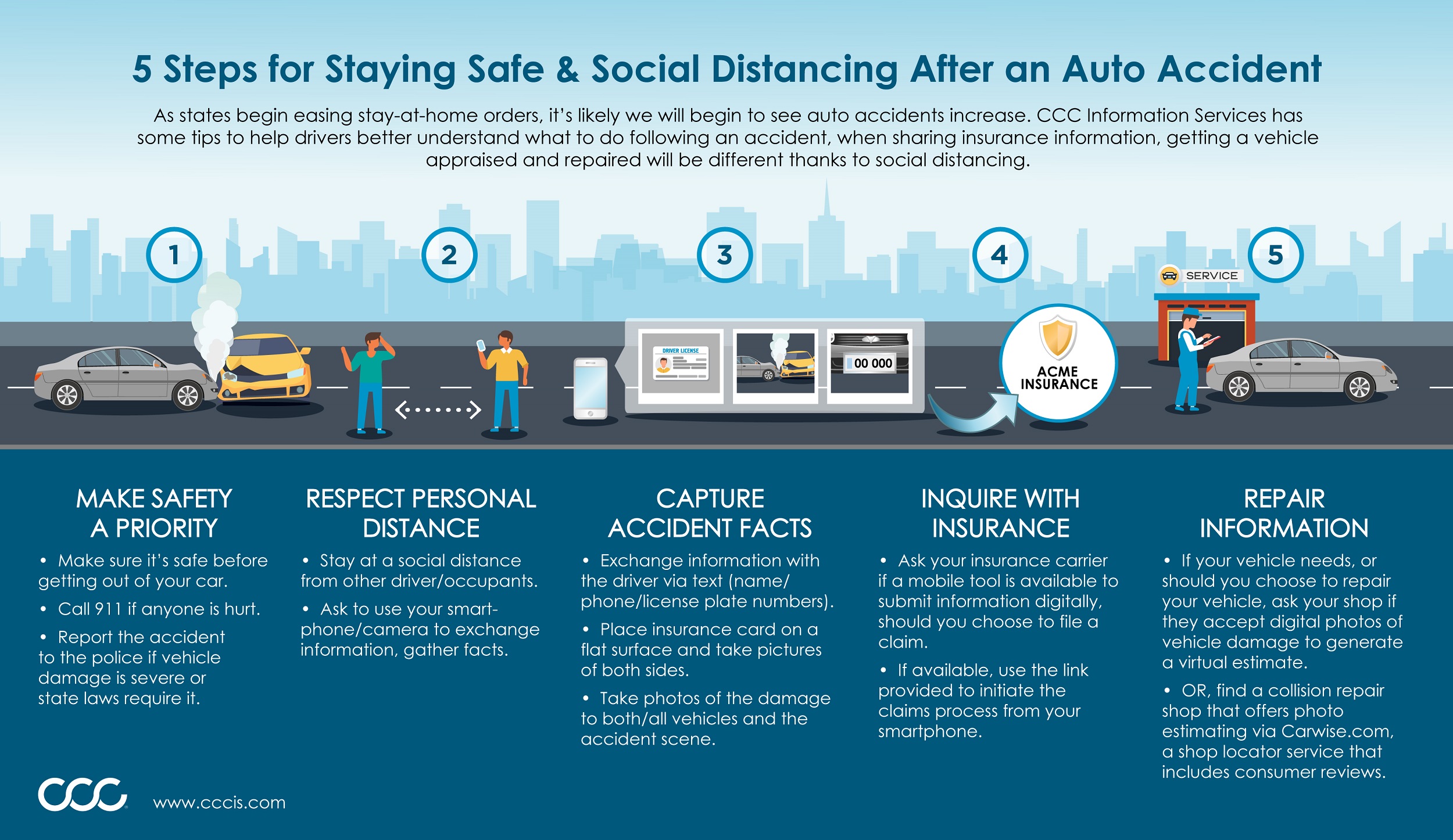
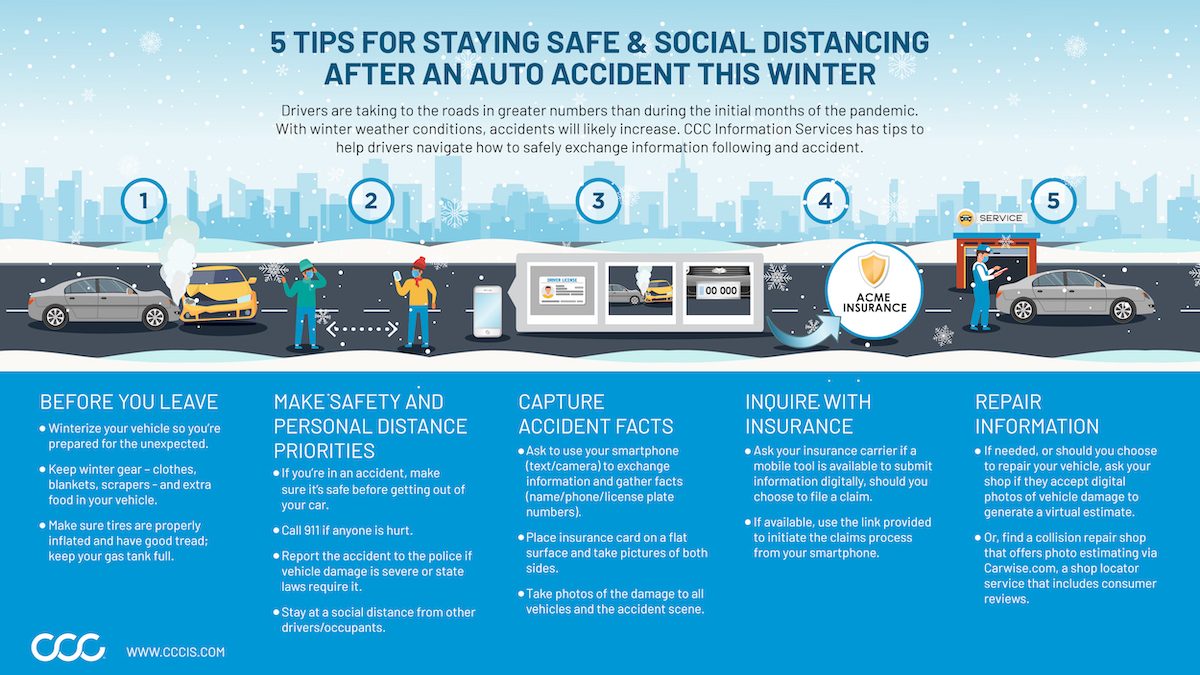
5 Steps for Staying Safe – Social Distancing After an Auto Accident

5 Steps for Staying Safe – Social Distancing After an Auto Accident

As some states begin easing stay-at-home orders, it’s likely that auto accidents may increase, yet COVID-19 cases are rising across the United States, which may also increase the risk for drivers to contract the virus after an accident occurs. Here are some tips to help drivers maintain social distancing measures following an accident during the pandemic as they share insurance information, get a vehicle appraised and repaired.

Make Safety a Priority

  • Make sure the roadway is safe before getting out of your car.
  • Call 911 if anyone is hurt.
  • Report the accident to the police if vehicle damage is severe or state law requires it.

Respect Personal Distance

  • Maintain a social distance of six feet from other drivers, occupants, and any first responders.
  • As an extra measure of precaution, consider wearing a mask when you interact with anyone at the scene of the accident.
  • Ask to use your smart-phone and camera to exchange information and gather facts.

Capture Accident Facts

  • Exchange information with the driver via text (name, phone, license plate numbers, as well as vehicle descriptions, including make, color, and model).
  • Place insurance card and driver’s license on a flat surface and take pictures of both sides, and share with the other driver(s).
  • Take photos of the damage to all vehicles involved and the accident scene.

Inquire with Insurance

When you contact your insurance carrier to inform them of the accident, ask if they have a mobile tool available to submit information digitally, should you choose to file a claim. If available, use the link provided to initiate the claims process from your smartphone.

Repair Information

If your vehicle requires, or should you choose to repair your vehicle, ask your shop if they accept digital photos of vehicle damage to generate a virtual estimate. You can also search for a collision repair shop that offers photo estimating via Carwise.com.

Accident Safety Infographic - Carwise.com
Click to enlarge

Read More
What is the Economic Impact of COVID-19 on the Collision Repair Industry?

What is the Economic Impact of COVID-19 on the Collision Repair Industry?

The COVID-19 pandemic has already changed the spending habits of most Americans. Nearly every sector in the US economy has been impacted by COVID-19, including the $50 billion a year collision repair industry. And although the recession has allowed some shops to catch up on backlogs and fill job vacancies, others are getting squeezed as people drive less and tighten their budgets. What follows are some ways that COVID-19 may be affecting the bottom line of the average collision repair shop near you. 

Auto Shops Remain Open

Since they are classified by the government as “essential” businesses, auto body and glass repair shops can still-remain open when other businesses can’t. CollisionWeek (CW) recently surveyed collision repair facilities across the US to determine how their business has changed over the past month and to get their economic projections for the rest of this year. Fortunately, CW discovered that 100% of the shops they contacted were still open for business. 

Car Businesses is Down in these States

However, 78% of shop respondents reported to CW that their sales had declined since the government first announced travel restrictions to slow down COVID-19’s spread. Only 9% of those shops surveyed indicated that their sales had increased over the past few weeks. 

CW learned that the states where business had declined the most were those that had implemented shelter-in-place orders early on, including Pennsylvania, California and New York. In fact, several respondents in those states mentioned that the number of repair jobs involving insurance claims had dropped dramatically due to stay-at-home orders and fewer traffic accidents. 

Some Car Shops Are Downsizing  

The US collision repair industry employs over 350,000 workers nationwide. Eventually, most body shops will no doubt feel the financial impact of the COVID-19 recession. But when asked by CW if they had recently laid-off workers due to declining business, only 18% of respondents said “yes”. And, most of the shops that had done so we’re in the same three states listed above. 

Supply Chain Disruptions For Collision Repair Shops

Collision repair shops also rely upon automotive parts manufacturers to supply them with both after-market and OEM parts. But a lot of parts factories have been forced to temporarily close due to COVID-19, including those in China.

As a result, nearly half of all respondents in the CW survey reported that they were experiencing supply shortages, with OEM parts being the hardest to obtain. Over 15% of respondents also mentioned that they were having trouble getting some of the paint supplies and other materials they needed. 

For safety reasons, body shop technicians are also required to wear N95 masks and other personal protective equipment (PPE). Due to the emergency reallocation of PPE to healthcare workers and first responders, some shops are also having a hard time purchasing enough PPE.

What Does the Future Hold For Auto Repair Shops?

CW also asked respondents to make business predictions for the next two months- specifically how long they could stay afloat if the COVID-19 crisis persists. Eight-out-of-ten shops felt confident that they could weather the financial storm even if it lasts for a while, with only around 9% indicating that they would be forced to close their doors for good.  

When asked by CW if they were confident that business would return to normal during the second half of 2020, a vast majority of survey respondents indicated that they thought it would. 

Over at CCC, a leading information services provider for the collision repair industry, they are also optimistic about the future of their clients. According to a recent article posted on CCC’s website, some industry insiders believe that COVID-19 will only cause a minor ripple in the collision repair sector, resulting in a temporary hiring slowdown in some states.  

But given that there’s already a shortage of technicians in the collision repair field, that may give the average shop a chance to catch up as new tech school graduates become available.  

Promptly Find Local Collision Repair Shops Here 

Even with fewer drivers on the road due to the COVID-19 pandemic, accidents still happen. When your ride’s been dinged up, promptly take it to one of the 19,000+ auto body and glass repair shops listed in the nationwide Carwise referral network. Once you do, I-CAR and ASE-certified collision repair professionals will promptly go to work restoring your vehicle like new again while putting your mind at ease.

Search your zip code now for a customer-reviewed auto body or glass repair shop nearby: www.carwise.com.

Read More
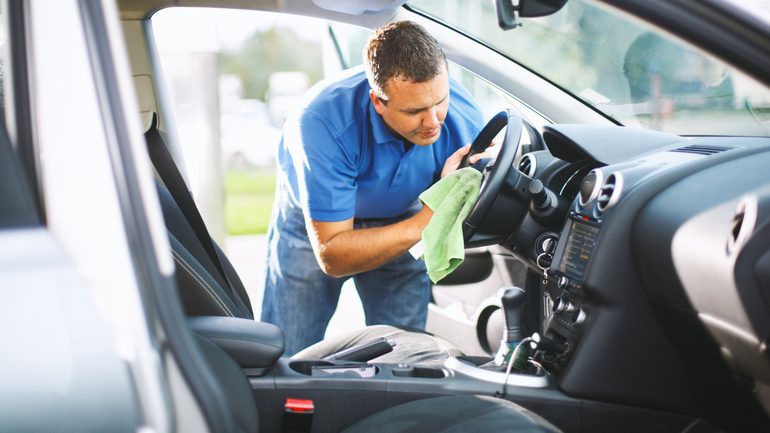
How Can I Clean & Disinfect the Inside of My Car?

How Can I Clean & Disinfect the Inside of My Car?

The average driver spends a lot of time inside their vehicle each week and some use it as their mobile office. Unfortunately, car interiors can be very dirty places where microorganisms thrive, including disease-causing bacteria and viruses. A recent study published by researchers from the UK’s University of Birmingham found that a children’s car seat may contain even more germs than the average toilet seat. To put your mind at ease, here are several reliable ways to clean and disinfect the inside of your car. 

Where Do Germs Hide Inside a Car?

Your car’s passenger compartment has a lot of features that can easily double as hiding places for pesky germs, such as:

Cabin air filter

If you leave your windows rolled up most of the time, your cabin air filter probably contains a lot of trapped mold spores, pollen grains, and germs. But when that filter gets too dirty it can’t do its job, which will eventually lower your cabin’s air quality.  

Upholstery

Carpet and seat upholstery attract food crumbs and other particles upon which bacteria and other microorganisms can grow. Door handles, dashboards, touch screens, shifters and steering wheels are typically covered in germs. 

Car keys

Your car keys are not only handled frequently, they also end up getting tossed on dirty surfaces that may contain numerous bacteria and viruses. When you pick those keys up the next morning, the germs hop on your skin. 

These Germs Live Inside Vehicles 

Some germs that can live inside your car may cause vomiting, diarrhea and coughing, while others make your throat sore or body ache. Here is a list of some of the more common germs that may be living inside your vehicle:

  • Cold and flu viruses like rhinovirus and influenza
  • Mold spores and allergens 
  • Intestinal organisms like E. Coli, salmonella and Norovirus 
  • Coronaviruses like COVID-19

How to Protect Your Vehicle’s Occupants 

Fortunately, there are several preventative measures you can take that will help keep unwanted “passengers” out and your vehicle’s occupants safer, starting with these:

Vacuum 

Give your vehicle’s interior a good vacuuming every month and be sure to use a brush attachment on the seat fabric and carpeting. Then, use a crevice tool to vacuum all the little nooks and crannies where food crumbs and bacteria congregate. Vacuum under the seats, between the seats and then be sure to thoroughly vacuum your child’s safety seat! 

Shampoo

Microscopic particles like pollen, dust and germs can infiltrate deep inside your carpet and seat upholstery. That’s why it’s also important to shampoo your cabin’s cloth material from time-to-time. Shampooing the floor mats and then hanging them outside to dry in the sunlight will also act as a disinfectant. If you don’t have time for a DIY upholstery shampoo, many auto body shops offer professional interior detailing services for the average driver. 

Disinfect

Some harmful viruses can live for weeks on exposed plastic, vinyl and metal surfaces, so wipe down your dash, trim, cup holders, door panels and consoles with reliable disinfectant wipes. You may even want to use a highly effective disinfectant spray to clean the air inside your passenger compartment. 

A/C & Cabin Filters

Your A/C and cabin filters are necessary to remove harmful particles from the passenger compartment, which means when they get clogged the air quality starts to diminish. Be sure to replace those filters based on the manufacturer’s recommendations found in your owner’s manual. A mechanic can also clean out your A/C vents for added protection. 

Promptly Find Local Collision Repair Shops Here 

When it’s time to find a local auto body or glass repair shop, isn’t it nice to know that you can promptly do so through the nationwide Carwise referral network? Not only that, all shops listed on Carwise are I-CAR and ASE certified, which means they employ knowledgeable collision repair professionals who are highly trained on the latest equipment and services to restore your ride like new again promptly and reliably. For your convenience, many collision repair shops also offer top-quality interior and exterior auto detailing as a value-added service. 

Search your zip code now for a customer-reviewed auto body or glass repair shop nearby: www.carwise.com.

Read More
1 5 6 7 8 9 21